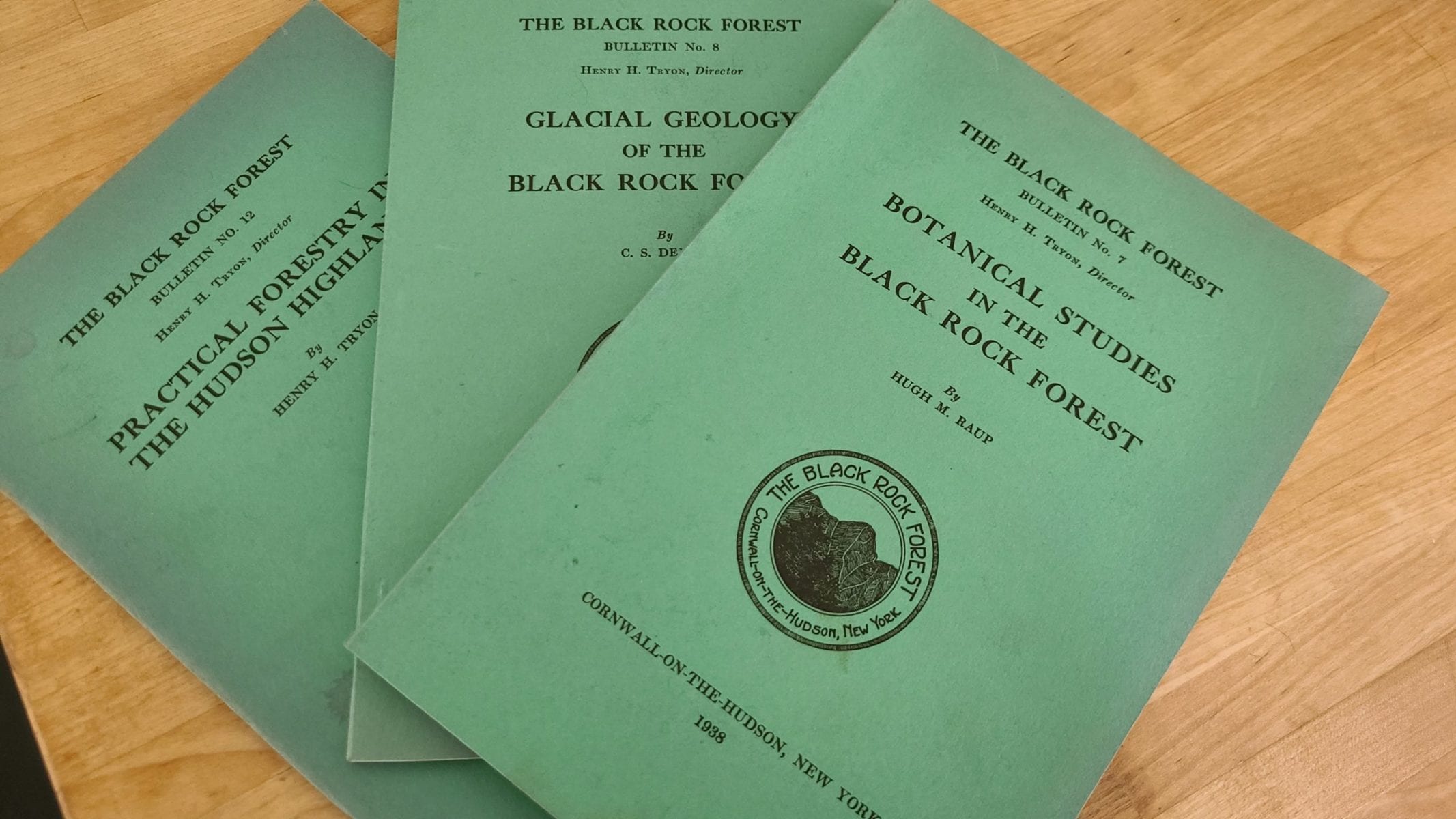

Research at Black Rock Forest spans a broad range of disciplines, with current research foci in forest ecology, wildlife ecology, invasive species management, and archeology. More than 300 books, journal articles, and theses have been produced by Black Rock Forest staff or by Forest guests since 1930.
See below for an incomplete list of publications, grouped by the categories below and sorted descending by year, written by Black Rock Forest staff or produced from data collected within the Forest. This list will be updated annually. If you are aware of a publication that does not appear below or would like to request a copy of an article that does not have a pdf linked, please email us at [email protected] to share an article or request a copy.
Consider following the Black Rock Forest Google Scholar page for new publication notifications.
Journal articles: peer-reviewed publications resulting from investigations conducted at least in part within Black Rock Forest or authored by Black Rock Forest staff.
Books and book chapters: content on Black Rock Forest or authored by Black Rock Forest staff.
Technical reports: content produced without peer review, by Black Rock Forest staff or pertaining to Black Rock Forest. Shared here for reference only.
Theses: undergraduate and graduate student theses whose work was conducted at least in part within Black Rock Forest, shared here for reference only.
All Black Rock Forest Bulletins and Papers are available at the Calvin Whitney Stillman Research Archive.
Journal articles:
Alston JM et al. 2026. Clarifying space use concepts in ecology: range vs. occurrence distributions. Ecology 10.1002/ecy.70300.
Herhold HW, Davis SR, Millena RJA, Eichert A, Markee A, Grimaldi DA. 2026. Convergence of alimentary air inflation and adult non-feeding in insects, and possible adaptive functions. PLoSOne 21(6) doi: 10.1371/journal.pone.0351543.
Kent DV, Lanci L, Peteet DM. 2026. Geomagnetic secular variation models for latitude scaling of cosmic ray flux and considerations for 10Be exposure dating of Laurentide Ice Sheet Retreat. Quaternary 8(3) 47 doi: 10.3390/quat8030047.
Lamour J et al. 2026. The Global Spectra-Trait Initiative: a database of paired leaf spectroscopy and functional traits associated with leaf photosynthetic capacity. Earth System Science Data 18(1) 245-265 doi: 10.5194/essd-18-245-2026.
Noonan MJ et al. 2026. The search behavior of terrestrial mammals. Nature Communications doi: tbd.
Oliver RY et al. 2026. Interacting effects of human mobility and landscape modification on wildlife. Science doi: 10.1126/science.adq339.
Rooney B et al. 2026. SNAPSHOT USA 2024: Year 6 of the coordinated national camera trap survey of the United States. Global Ecology and Biogeography doi: 10.1111/geb.70229.
Terlizzi KP, Heslop CB, Taylor BN, Schuster WSF, Palmer MI. 2026. Oak mortality in combination with deer browse alters understory community composition and increases non-native species abundance in the Northeastern United States. Forest Ecology and Management doi: 10.1016/j.foreco.2025.123294.
Helms A, Huddell A, Liao W, Staccone A, Buckley B, Schuster WSF, Menge D. 2025. Robinia pseudoacacia, a nitrogen fixing tree, facilitates the future growth of neighboring trees. Canadian Journal of Forest Research 10.1139/cjfr-2024-0183.
Makowski H, Lamb K, Kim AM, Scott E, Galloway LF. 2025. Trait specialization facilitates autonomous selfing ability in a mixed-mating plant. American Journal of Botany 112(9)e70095 10.1002/ajb2.70095.
Matthes JH, Reinmann A, Naughton H, Gewirtzman J, Pederson N. 2025. Impacts and legacies of extreme precipitation on temperate forests during critical ecological windows. Annual Review of Ecology, Evolution, and Systematics doi: 10.1146/annurev-ecolsys-102723042035.
McCulloch LA, Berlingeri C, Chari N, Church L, Prada CM, Schuster WSF, Terlizzi KP, Taylor BN. 2025. Loss of dominant tree-mycorrhizal mutualism increases soil fungal diversity and alters community structure. Functional Ecology 39(9) 2425-2436 doi: 10.1111/1365-2435.70126.
Parlin AF, Horning NA, Alstad JP, Cosentino BJ, Gibbs JP. 2025. Low-cost, LoRa GNSS tracker for wildlife monitoring. HardwareX 23 doi: 10.1016/j.ohx.2025.e00669.
Payne HL & Aronov D. 2025. Remote activation of place codes by gaze in a highly visual animal. Nature 643(8073) 1037-1043 doi: 10.1038/s41586-025-09101-z.
Peteet DM, Ibe R, Stone E, Zajac C, Chang C. 2025. Paleoecological history of Maplecrest Fen, Catskill Mountains (NY, USA) from deglaciation to the Industrial Age. Journal of Biogeography 52(4) doi: 10.1111/jbi.15052.
Rooney B et al. SNAPSHOT USA 2019–2023: the first five years of data from a coordinated camera trap survey of the United States. Global Ecology and Biogeography 10.1111/geb.13941.
Trombley J, Celenza JL, Frey SD, Anthony MA. 2025. Arbuscular mycorrhizal fungi boost development of an invasive Brassicaceae. Plant, Cell & Environment 48(7) 4928-4937 doi: 10.1111/pce.15508.
Young J et al. 2025. Large-scale experimental assessment of coyote behavior across urban and rural landscapes. Scientific Reports 10.1038/s41598-025-33189-y.
Balter-Kennedy A, Schaefer JM, Balco G, Kelly MA, Kaplan MR, Schwartz R, Oakley B, Young NE, Hanley J, Varuolo-Clarke AM. 2024. The Laurentide Ice Sheet in southern New England and New York during and at the end of the Last Glacial Maximum: a cosmogenic-nuclide chronology. Climate of the Past 20(9) 2167-2190 doi: 10.5194/cp-20-2167-2024.
Chettih SN, Mackevicius EL, Hale S, Aronov D. 2024. Barcoding of episodic memories in the hippocampus of a food-caching bird. Cell 187(8) 1922-1935 doi: 10.1016/j.cell.2024.02.032.
Kays R et al. 2024. Climate, food and humans predict communities of mammals in the United States. Diversity and Distributions 10.1111/ddi.13900.
Makowski H, Lamb K, Galloway LF. 2024. Support for Baker’s law: facultative self-fertilization ability decreases pollen limitation in experimental colonization. American Journal of Botany 111(6)e16351 10.1002/ajb2.16351.
Makowski H, Scott E, Lamb K, Galloway LF. 2024. Compensating for the corolla? Pollen exposure is not associated with pollen collecting hair length. Annals of Botany 134(6):1027-1036 10.1093/aob/mcae139
Millena RJA, Eichert A, Ware JL. 2024. Collection methods and distribution modeling for Strepsiptera in the United States. Environmental Entomology 53(4) 740-750 doi: 10.1093/ee/nvae042.
Shamon H et al. 2024. SNAPSHOT USA 2021: A third coordinated national camera trap survey of the United States. Ecology 10.1002/ecy.4318.
Warner K, Falxa Sonti N, Cook EM, Hallett RA, Hutyra LR, Reinmann AB. 2024. Urbanization exacerbates climate sensitivity of eastern United States broadleaf trees. Ecological Applications 34(4) doi: 10.1002/eap.2970.
Akana PR, Mifsud IEJ, Menge DNL. 2023. Soil nitrogen availability in a temperate forest exhibits large variability at sub-tree spatial scales. Biogeochemistry 164(3) 537-553 doi: 10.1007/s10533-023-01056-5.
Applegate MC, Gutnichenko KS, Aronov D. 2023. Topography of inputs into the hippocampal formation of a food-caching bird. Journal of Comparative Neurology 531(16) 1669-1688 doi: 10.1002/cne.25533.
Applegate MC, Gutnichenko KS, Mackevicius EL, Aronov D. 2023. An entorhinal-like region in food-caching birds. Current Biology 33(12) 2465-2477 doi: 10.1016/j.cub.2023.05.031.
Brenner L, Mailloux BJ, Rodriguez S, Maenza-Gmelch T, Cook EM, Koli F, Marizzi C, Frawley RJ, Saad B, Stute M. 2023. Supporting the Next Generation of Leaders in the Geosciences: Barnard’s Environmental Science Pathways Scholar Program. Oceanography 36(4) doi: 10.5670/oceanog.2024.101.
Bytnerowicz TA, Funk JL, Menge DNL, Perakis SS, Wolf AA. 2023. Leaf nitrogen affects photosynthesis and water use efficiency similarly in nitrogen-fixing and non-fixing trees. Journal of Ecology 111(11) 2457-2471 doi: 10.1111/1365-2745.14194.
Carreras Pereira KA, Wolf AA, Kou-Giesbrecht S, Akana PR, Funk JL, Menge DNL. 2023. Allometric relationships for eight species of 4–5 year old nitrogen-fixing and non-fixing trees. PLoS ONE doi: 10.1371/journal.pone.0289679.
Davidson KJ, Lamour J, McPherran A, Rogers A, Serbin SP. 2023. Seasonal trends in leaf-level photosynthetic capacity and water use efficiency in a North American Eastern deciduous forest and their impact on canopy-scale gas exchange. New Phytologist 240(1) 138-156 doi: 10.1111/nph.19137.
Jager EA, Quebbeman AW, Wolf AA, Perakis SS, Funk JL, Menge DNL. 2023. Symbiotic nitrogen fixation does not stimulate soil phosphatase activity under temperate and tropical trees. Oecologia 201(3) 827-840 doi: 10.1007/s00442-023-05339-4.
Menge DNL, Wolf AA, Funk JL, Perakis SS, Akana PR, Arkebauer R, Bytnerowicz TA,Carreras Pereira KA, Huddell AM, Kou-Giesbrecht S, Ortiz SK. 2023. Tree symbioses sustain nitrogen fixation despite excess nitrogen supply. Ecological Monographs 93(2) doi: 10.1002/ecm.1562.
Mifsud IEJ, Akana PR, Bytnerowicz TA, Davis SR, Menge DNL. 2023. Nitrogen fixation in the stag beetle, Ceruchus piceus (Coleoptera: Lucanidae): could insects contribute more to ecosystem nitrogen budgets than previously thought? Environmental Entomology 52(4) 618-626 doi: 10.1093/ee/nvad053.
Reinmann AB, Bowers JT, Kaur P, Kohler C. 2023. Compensatory responses of leaf physiology reduce effects of spring frost defoliation on temperate forest tree carbon uptake. Frontiers in Forests and Global Change doi: 10.3389/ffgc.2023.988233.
Schmiege SC, Griffin KL, Boelman BT, Vierling LA, Bruner SG, Min E, Maguire AJ, Jensen J, Eitel JUH. 2023. Vertical gradients in photosynthetic physiology diverge at the latitudinal range extremes of white spruce. Plant, Cell and Environment 46(1) 45-63 doi: 10.1111/pce.14448.
Soccorsi AE & LaPoint SD. 2023. Assessing spatiotemporal patterns of mesocarnivores along an urban to-rural gradient. Journal of Wildlife Management 10.1002/jwmg.22474.
Anderegg WRL, Chegwidden OS, Badgley G, Trugman AT, Cullenward D, Abatzoglou JT, Hicke JA, Freeman J, Hamman JJ. 2022. Future climate risks from stress, insects and fire across US forests. Ecology Letters 10.1111/ele.14018.
Applegate MC & Aronov D. 2022. Flexible use of memory by food-caching birds. eLife doi: 10.7554/eLife.70600.
Badgley G, Freeman J, Hamman JJ, Haya B, Trugman AT, Anderegg WR, Cullenward D. 2022. Systematic over-crediting in California’s forest carbon offsets program. Global Change Biology 28(4) 1433-1445.
Broekman MJE et al. 2022. Evaluating expert‐based habitat suitability information of terrestrial mammals with GPS‐tracking data. Global Ecology and Biogeography 31(8) 1526-1541 doi: 10.1111/geb.13523.
Coffield SR, Vo CD, Wang JA, Badgley G, Goulden ML, Cullenward D, Anderegg WRL, Randerson JT. 2022. Using remote sensing to quantify the additional climate benefits of California forest carbon offset projects. Global Change Biology 28(22) 6789-6806 doi: 10.1111/gcb.16380.
Dechant B, Ryu Y, Badgley G, Köhler P, Rascher U, Migliavacca M, Zhang Y, Tagliabue G, Guan K, Rossini M, Goulas Y, Zeng Y, Frankenberg C, Berry JA. 2022. NIRVP: a robust structural proxy for sun-induced chlorophyll fluorescence and photosynthesis across scales. Remote Sensing of Environment 268(2022) 112763 doi: 10.1016/j.rse.2021.112763.
Eiseman CS, Smith DR, Sheehan B, Feldman TS. 2022. Macrophya Dahlbom spp. (Hymenoptera: Tenthredinidae) feeding on Asteraceae. Proceedings of the Entomological Society of Washington 124(1) 39-45 doi: 10.4289/0013-8797.124.1.39.
Griffin KL, Griffin ZM, Schmiege SC, Bruner SG, Boelman NT, Vierling LA, Eitel JUH. 2022. Variation in White spruce needle respiration at the species range limits: a potential impediment to Northern expansion. Plant, Cell and Environment 45(7) 2078-2092 doi: 10.1111/pce.14333.
Anderegg WR, Chegwidden OS, Badgley G, Trugman AT, Cullenward D, Abatzoglou JT, Hicke JA, Freeman J, Hamman JJ. 2021. Climate risks to carbon sequestration in US forests. bioRxiv 10.1101/2021.05.11.443688.
Cove MV et al. 2021. SNAPSHOT USA 2019: a coordinates national camera trap survey of the United States. Ecology 10.1002/ecy.3353.
Fleming CH et al. 2021. A comprehensive framework for location error in animal tracking data. bioRxiv. 10.1101/2020.06.12.130195.
Kou-Giesbrecht S, Funk JL, Perakis SS, Wolf AA, Menge DNL. 2021. N supply mediates the radiative balance of N2O emissions and CO2 sequestration driven by N-fixing vs. non-fixing trees. Ecology 102(8) doi: 10.1002/ecy.3414.
Odom RH & Ford WM. 2021. Developing species-age cohorts from Forest Inventory and Analysis data to parametrize a forest landscape model. International Journal of Forest Research. 10.1155/2021/6650821.
Piana MR, Hallett RA, Aronson MFL, Conway E, Handel SN. 2021. Natural regeneration in urban forests is limited by early-establishment dynamics: implications for management. Ecological Applications 31(2) doi: 10.1002/eap.2255.
Sonti NF, Hallett RA, Griffin KL, Trammell TLE, Sullivan JH. 2021. Chlorophyll fluorescence parameters, leaf traits and foliar chemistry of white oak and red maple trees in urban forest patches. Tree Physiology 41(2) 269-279 doi: 10.1093/treephys/tpaa121.
Zeng Y, Hao D, Badgley G, Damm A, Rascher U, Ryu Y, Johnson JE, Krieger V, Wu S, Qiu H, Liu Y, Berry JA, Chen M. 2021. Estimating near-infrared reflectance of vegetation from hyperspectral data. Remote Sensing of Environment 10.1016/j.rse.2021.112723.
Anderegg WR, Trugman AT, Badgley G, Anderson CM, Bartuska A, Ciais P, Cullenward D, Field CB, Freeman J, Goetz SJ, Hicke JA, Huntzinger D, Jackson RB, Nickerson J, Pacala S, Randerson JT. 2020. Climate-driven risks to the climate mitigation potential of forests. Science 368(6497) 10.1126/science.aaz700.
Anderegg WR, Trugman AT, Badgley G, Konings AG, Shaw J. 2020. Divergent forest sensitivity to repeated extreme droughts. Nature Climate Change 10, 1091–1095 10.1038/s41558-020-00919-1.
Davidson SC et al. 2020. Ecological insights from the three decades of animal movement tracking across a changing Arctic. Science 370(6517) 712-715 10.1126/science.abb7080.
Dechant B, Ryu Y, Badgley G, Köhler P, Rascher U, Migliavacca M, Zhang Y, Tagliabue G, Guan K, Rossini M, Goulas Y, Zeng Y, Frankenberg C, Berry JA. 2020. NIRvP: a robust structural proxy for sun-induced chlorophyll fluorescence and photosynthesis across scales. Remote Sensing of Environment 268 10.1016/j.rse.2021.112763.
Miller JS. 2020. Not too big, not too small: raids at moderately sized hosts lead to optimal outcomes for a slave-making ant. Behavior Ecology & Sociobiology 74(2) 1-13.
Nieukerken EJ & Eiseman CS. 2020. Splitting the leafmining shield-bearer moth genus Antispila Hübner (Lepidoptera, Heliozelidae): North American species with reduced venation placed in Aspilanta new genus, with a review of heliozelid morphology. ZooKeys 957, 105-161.
Noonan MJ et al. 2020. Effects of body size on estimation of mammalian area requirements. Conservation Biology 34(4) 1017-1028.
Sonti NF, Halley RA, Griffin KL, Trammell TLE, Sullivan JH. 2020. Cholorphyll fluorescence parameters, leaf traits and foliar chemistry of white oak and red maple trees in urban forest patches. Tree Physiology. 41(2): 269-279.
Whelan ME, Anderegg LD, Badgley G, Campbell JE, Commane R, Frankenberg C, Hilton TW, Kuai L, Parazoo N, Shiga Y. 2020. Scientific communities striving for a common cause: innovations in carbon cycle science. Bulletin of the American Meteorological Society 101.9, E1537–E1543 10.1175/BAMS-D-19-0306.1.
Xu M. 2020. Parametrized maximum entropy models predict variability of metabolic scaling across tree communities and populations. Ecology 101(6) 10.1002/ecy.3011.
Boelman NT, Liston GE, Hebblewhite M, Prugh LR, Meddens AJH, Kimball JS, Mahoney PJ, Gurarie E, Nolin AW, Kirchner PB, Cosgrove CL, Bohrer G, LaPoint SD, Vierling LA, Eitel JUH, Brinkman TJ, Pedersen SH. 2019. Integrating snow science and wildlife ecology in Arctic-boreal North America. Environmental Research Letters 14(1): 010401 10.1088/1748-9326/aaeec1
Hofman MPG. et al. 2019. Right on track? Performance of satellite telemetry in terrestrial wildlife research PLoS One 10.1371/journal.pone.0216223
Levesque M, Andreu-Hayles L, Smith WK, Williams AP, Hobi ML, Allred BW, Pederson N. 2019. Tree-ring isotopes capture interannual vegetation productivity dynamics at the biome scale. Nature Communications doi: 10.1038/s41467-019-08634-y.
Li X, Xu C, Li Z, Feng J, Tissue DT, Griffin K. 2019. Late growing season carbon subsidy in native gymnosperms in a northern temperate forest. Tree Physiology 39(6):971-982 10.1093/treephys/tpz024.
Reid BN, Kass JM, Wollney S, Jensen EL, Russello MA, Viola EM, Pantophlet J, Iverson JB, Peery MZ, Raxworthy CJ, Naro-Maciel E. 2019. Disentangling the genetic effects of refugial isolation and range expansion in a trans-continentally distributed species. Heredity 122(4) 441-457 doi: 10.1038/s41437-018-0135-5.
Tucker MA. et al. 2019. Large birds travel farther in homogeneous environments. Global Ecology and Biogeography 28(5):576-587 10.1111/geb.12875.
Case M & Stinson KA. 2018. Climate change impacts on the distribution of the allergenic plant, common ragweed (Ambrosia artemisiifolia) in the eastern United States. PLoSOne 13(10)e0205677 10.1371/journal.pone.0205677.
Haines DF, Aylward JA, Frey SD, Stinson KA. 2108. Regional patterns of floristic diversity and composition in forests invaded by garlic mustard (Alliaria petiolata). Northeastern Naturalist 25(3):399-417 10.1656/045.025.0307.
Lázaro J, Hertel M, LaPoint S, Wikelski M, Stiehler M, Dechmann DKN. 2018. Cognitive skills of common shrews (Sorex araneus) vary with seasonal changes in skull size and brain mass. Journal of Experimental Biology 221(2) doi: 10.1242/jeb.166595.
Patterson AE, Arkebauer R, Quallo C, Heskel MA, Li X, Boelman N, Griffin KL. 2018. Temperature response of respiration and respiratory quotients of 16 co-occuring temperate tree species. Tree Physiology 38(9): 1319–1332 10.1093/treephys/tpx176.
Record S, McCabe T, Baiser B, Ellison AM. 2018. Identifying foundation species in North American forests using long-term data on ant assemblage structure. Ecosphere 9(3):e02139 10.1002/ecs2.2139.
Tucker MA et al. 2018. Moving in the Anthropocene: global reductions in terrestrial mammalian movements. Science 359(6374) 466-469 doi: 10.1126/science.aam9712.
Anthony MA, Frey SD, Stinson KA. 2017. Fungal community homogenization, shift in dominant trophic guild, and appearance of novel taxa with biotic invasion. Ecosphere 8(9) doi: 10.1002/ecs2.1951.
Duveneck MJ & Thompson JR. 2017. Climate change imposes phenological trade-offs on forest net primary productivity. Journal of Geophysical Research: Biogeosciences 122(9) 2298-2313 doi: 10.1002/2017JG004025.
Duveneck MJ, Thompson JR, Gustafson EJ, Liang Y, deBruijn AMG. 2017. Recovery dynamics and climate change effects to future New England forests. Landscape Ecology 32(7) 1385-1397 doi: 10.1007/s10980-016-0415-5.
Kutter E, Yi C, Hendrey G, Liu H, Eaton T, Ni-Meister W. 2017. Recirculation over complex terrain. Journal of Geophysical Research: Atmospheres 122(12) 6637-6651 doi: 10.1002/2016JD026409.
Levesque M, Andreu-Hayles L, Pederson N. 2017. Water availability drives gas exchange and growth of trees in northeastern US, not elevated CO2 and reduced acid deposition. Scientific Reports 7(1) doi: 10.1038/srep46158.
O’Sullivan OS, Heskel MA, Reich PB, Tjoelker MG, Lasantha K, Weerasinghe LK, Penillard A, Zhu L, Egerton JG, Bloomfield KJ, Creek D, Bahar NHA, Griffin KL, Hurry V, Meir P, Turnbull MH, Atkin OK. 2017. Thermal limits of leaf metabolism across biomes. Global Change Biology 23(1) 209-223 doi: 10.1111/gcb.13477.
Taylor BN et al. 2017. Growth and physiology of a dominant understory shrub Hamamelis virginiana, following canopy disturbance in a temperate hardwood forest. Canadian Journal of Forest Research 47(2) 193-202 doi: 10.1139/cjfr-2016-0208.
Heskel MA, O’Sullivan OS, Reich PB, Tjoelker MG, Weerasinghe LK, Penillard A, Egerton JJG, Creek D, Bloomfield KJ, Xiang J, Sinca F, Stangl ZR, Martinez-de la Torre A, Griffin KL, Huntingford C, Hurry V, Meir P, Turnbull MH, Atkin OK. 2016. Convergence in the temperature response of leaf respiration across biomes and plant functional types. Proceedings of the National Academy of Sciences U.S.A. 113(14) 3832-3837 doi: 10.1073/pnas.1520282113.
Naeem S, Prager C, Weeks B, Varga A, Flynn DFB, Griffin KL, Muscarella R, Wood S, Schuster WSF. 2016. Biodiversity as a multidimensional construct: a review, framework and case study of herbivory’s impact on plant diversity. Proceedings of the Royal Society B 283(1844) doi: 10.1098/rspb.2015.3005.
Xu M. 2016. Ecological scaling laws link individual body size variation to population abundance fluctuation. Oikos 125(3): 288-299 doi: 10.1111/oik.03100.
Atkin OK et al. 2015. Global variability in leaf respiration in relation to climate, plant functional types and leaf traits. New Phytologist 206(2) 614-636 doi: 10.1111/nph.13253.
Cohen JE & Xu M. 2015. Random sampling of skewed distributions implies Taylor’s power law of fluctuation scaling. Proceedings of the National Academy of Sciences U.S.A. 112(25) 7749-7754 doi: 10.1073/pnas.1503824112.
Eisen K & Plotkin AB. 2015. Forty years of forest measurements support steadily increasing aboveground biomass in a maturing, Quercus-dominant northeastern forest. The Journal of the Torrey Botanical Society 142(2) 97-112 doi: 10.3159/TORREY-D-14-00027.1.
Giometto A, Formentin M, Rinaldoa A, Cohen JE, Maritan A. 2015. Sample and population exponent of generalized Taylor’s law. Proceedings of the National Academy of Sciences U.S.A. 112(25) 7755-7760 doi: 10.1073/pnas.1505882112.
Jackson AK, Evers DC, Adams EM, Cristol DA, Eagles-Smith C, Edmonds ST, Gray CE, Hoskins B, Lane OP, Sauer A, Tear T. 2015. Songbirds as sentinels of mercury in terrestrial habitats of eastern North America. Ecotoxicology 24(2) 453-467 doi: 10.1007/s10646-014-1394-4.
Rubino L, Charles S, Sirulnik AG, Tuininga AR, Lewis JD. 2015. Invasive insect effects on nitrogen cycling and host physiology are not tightly linked. Tree Physiology 35(2) 124-133 doi: 10.1093/treephys/tpv004.
Xu M, Schuster WSF, Cohen JE. 2015. Robustness of Taylor’s law under spatial hierarchical groupings of forest tree samples. Population Ecology 57(1) 93-103 doi: 10.1007/s10144-014-0463-0.
Comas LH, Callahan HS, Midford PE. 2014. Patterns in root traits of woody species hosting arbuscular and ectomycorrhizas: implications for the evolution of belowground strategies. Ecology and Evolution 4(15) 2979-2990 doi: 10.1002/ece3.1147.
Falxa-Raymond N, Palmer MI, McPhearson T, Griffin KL. 2014. Foliar nitrogen characteristics of four tree species planted in New York City forest restoration sites. Urban Ecosystems 17(3) 807-824 doi: 10.1007/s11252-014-0346-3.
Gillet A & Seewagen CL. 2014. Mercury exposure of a wetland songbird, Agelaius phoeniceus, in the New York metropolitan area and its effect on nestling growth rate. Environmental Monitoring and Assessment 186(7) 4029-4036 doi: 10.1007/s10661014-3677-x.
Levy-Varon JH, Schuster WSF, Griffin KL. 2014. Rapid rebound of soil respiration following partial stand disturbance by tree girdling in a temperate deciduous forest. Oecologia 174(4) 1415-1424 doi: 10.1007/s00442-013-2844-z.
Ovtsharenko VI, Tanasevitch AV, Zakharov BP. 2014. A survey of the spiders of Black Rock Forest Preserve in New York (Arachnida: Araneae). Entomologica Americana 120(1) 24-38 doi: 10.1664/14-RA-013.1.
Cohen J E, Xu M, Schuster WSF. 2013. Stochastic multiplicative population growth predicts and interprets Taylor’s power law of fluctuation scaling. Proceedings of the Royal Society B 280(1757) doi: 10.1098/rspb.2012.2955.
Cohen JE, Xu M, Schuster WSF. 2012. Allometric scaling of population variance with mean body size is predicted from Taylor’s law and density-mass allometry. Proceedings of National Academy of Science U.S.A. 109(39) 15829-15834 doi: 10.1073/pnas.1212883109.
Falxa-Raymond N, Patterson AE, Schuster WSF, Griffin KL. 2012. Oak loss increases foliar nitrogen, δ15N and growth rates of Betula lenta in Black Rock Forest, Hudson Highlands, Southeastern New York State, USA. Tree Physiology 32(9) 1092-1101 doi: 10.1093/treephys/tps068.
Levy-Varon J, Schuster WSF, Griffin KL. 2012. The autotrophic contribution to soil respiration in a northern temperate deciduous forest and its response to stand disturbance. Oecologia 169(1) 211-220.
Patterson AE. 2012. Warming climates, changing forests: temperature tolerances of trees and carbon dynamics in northeastern temperate forests. Consilience: The Journal of Sustainable Development 9(1): 160-171.
Searle SY, Turnbull MH, Boelman NT, Schuster WSF, Griffin KL. 2012. Urban environment of New York City promotes growth in northern red oak seedlings. Tree Physiology 32(4) 389-400 doi: 10.1093/treephys/tps027.
Wyner Y & Berkov A. 2012. The impact of an extended outdoor residential workshop on urban students’ learning and appreciation of biodiversity. Cities and The Environment 5(1) 1-17 doi: 10.15365/cate.51122012.
Xu C-Y, Turnbull MH, Tissue DT, Lewis JD, Carson R, Schuster WSF, Whitehead D, Walcroft AD, Li J, Griffin KL. 2012. Age-related decline of stand biomass accumulation is primarily due to mortality and not to reduction in NPP associated with individual tree physiology, tree growth or stand structure in a Quercus-dominated forest. Journal of Ecology 100(2) 428-440 doi: 10.1111/j.1365-2745.2011.01933.x.
Searle SY, Bitterman DS, Thomas S, Griffin KL, Atkin OK, Turnbull MH. 2011. Respiratory alternative oxidase responds to both low- and high-temperature stress in Quercus rubra leaves along an urban-rural gradient in New York. Functional Ecology 25(5) 1007-1017.
Abbott DH, Gerard Little P, Coste Sa, Coste St, Breger D, Haslett S. 2010. Exotic grains in a core from Cornwall, NY- Do they have an impact source? Journal of Siberian Federal University: Engineering and Technologies 1(3) 5-29 doi: 10.7916/D8J67GQX.
Hotopp KP, Pearce TA, Nekola JC, Schmidt K. 2010. New land snail (Gastropoda: Pulmonata) distribution records for New York State. Proceedings of the Academy of Natural Sciences of Philadelphia 159(1) 25-30.
Munshi-South J & Kharchenko K. 2010. Rapid, pervasive genetic differentiation of urban white footed mouse (Peromyscus leucopus) populations in New York City. Molecular Ecology 19(19) 4242-4254 doi: 10.1111/j.1365-294X.2010.04816.x.
Boyd JN, Xu C-Y, Griffin KL. 2009. Cost-effectiveness of leaf energy and resource investment of invasive Berberis thunbergii (Japanese barberry) and co-occurring native shrubs. Canadian Journal of Forest Research 39(11) 2109-2118 doi: 10.1139/X09-128.
Turner GD, Lewis JD, Mates-Muchin JT, Schuster WSF, Watt L. 2009. Light availability and soil moisture influence ectomycorrhizal fungal communities on oak seedlings grown in oak- and hemlock-associated soils. Canadian Journal of Forest Research 39(7) 1247-1258 doi: 10.1139/X09-051.
Bowman WP, Turnbull MH, Tissue DT, Whitehead D, Griffin KL. 2008. Sapwood temperature gradients between lower stems and the canopy do not influence estimates of standlevel stem CO2 efflux. Tree Physiology 28(10) 1553-1559 doi: 10.1093/treephys/28.10.1553.
Kays RW, Gompper MW, Ray JC. 2008. Landscape ecology of eastern coyotes based on large-scale estimates of abundance. Ecological Applications 18:1014-1027.
Li J, Xu C-Y, Griffin KL, Schuster WSF. 2008. Dendrochronological potential of Japanese barberry (Berberis thunbergii): a case study in the Black Rock Forest, New York. Tree-Ring Research 64(2) 115-124 doi: 10.3959/2008-5.1.
Matteson KC, Ascher JS, Langellotto GA. 2008. Bee richness and abundance in New York City urban gardens. Annals of the Entomological Society of America 101(1) 140-150.
Carpi A, Frei A, Cocris D, McCloskey R, Contreras E, Ferguson K. 2007. Analytical artifacts produced by a polycarbonate chamber compared to a Teflon chamber for measuring surface mercury fluxes. Analytical and Bioanalytical Chemistry 388(2) 361-365 doi: 10.1007/s00216-006-1111-0.
Dunn RR & Danoff-Burg JA. 2007. Road size and carrion beetle assemblages in a New York forest. Journal of Insect Conservation 11(4) 325–332 doi: 10.1007/s10841-006-9047-4.
Ellison AM, Record S, Arguello A, Gotelli NJ. 2007. Rapid inventory of the ant assemblage in a temperate hardwood forest: species composition and assessment of sampling methods. Environmental Entomology 36(4) 766-775 doi: 10.1603/0046-225X(2007)36[766:RIOTAA]2.0.CO;2.
Shapiro JB, Simpson HJ, Griffin KL, Schuster WSF. 2007. Precipitation chloride at West Point, NY: seasonal patterns and possible contributions from non-seawater sources. Atmospheric Environment 41(10) 2240-2254 doi: 10.1016/j.atmosenv.2006.03.049.
Xu C-Y, Griffin KL, Schuster WSF. 2007. Leaf phenology and seasonal variation of photosynthesis of invasive (Berberis thunbergii) Japanese barberry and two co-occurring native understory shrubs in a northeastern US deciduous forest. Oecologia 154(1) 11-21.
Xu C-Y, Schuster WSF, Griffin KL. 2007. Seasonal variation of temperature response of respiration in invasive (Berberis thunbergii) Japanese barberry and two co-occurring native understory shrubs in a northeastern United States deciduous forest. Oecologia 153(4) 809-819 doi: 10.1007/s00442-007-0790-3.
Giles V & Ascher JS. 2006. A survey of the bees of the Black Rock Forest Preserve, New York (Hymenoptera: Apoidea). Journal of Hymenoptera Research 15(2) 208-231.
Nelson PK & Barringer KB. 2006. Mosses from Black Rock Forest, Orange County, New York. Journal of the Torrey Botanical Society 133(3) 490-493.
Warrach K, Stieglitz M, Shaman J, Engel VC, Griffin KL. 2006. Twentieth century climate in the New York Hudson Highlands and the potential impacts on ecohydrological processes. Climatic Change 75(4) 455-493 doi: 10.1007/s10584-006-6337-5.
Xu C-Y & Griffin KL. 2006. Seasonal variation in the temperature response of leaf respiration in Quercus rubra: foliage respiration and leaf properties. Functional Ecology 20(5) 778-789.
Cohn JP. 2005. Urban Wildlife. BioScience 55(3) 201-205.
Fener HM, Ginsberg JR, Sanderson E, Gompper ME. 2005. Chronology of range expansion of the coyote (Canis latrans) in New York. Canadian Field Naturalist 119(1) 1-5 doi: 10.22621/cfn.v119i1.74.
Gompper ME & Wright AN. 2005. Altered prevalence of raccoon roundworm (Baylisascaris procyonis) owing to manipulated contact rates of hosts. Journal of Zoology 266(2) 215- 219 doi: 10.1017/S0952836905006813.
Wright AN & Gompper ME. 2005. Altered parasite assemblages in raccoons in response to manipulated resource availability. Oecologia 144(1) 148-156 doi: 10.1007/s00442-005-0018-3.
Nagel JM & Griffin KL. 2004. Can gas-exchange characteristics help explain the invasive success of Lythrum salicaria? Biological Invasions 6(1) 101-111 doi: 10.1023/B:BINV.0000010125.93370.32.
Pederson N, Cook ER, Jacoby GC, Peteet DM, Griffin KL. 2004. The influence of winter temperatures on the annual radial growth of six northern range margin tree species. Dendrochronologia 22(1) 7-29 doi: 10.1016/j.dendro.2004.09.005.
Whitehead D, Griffin KL, Turnbull MH, Tissue DT, Engel VC, Brown KJ, Schuster WSF, Walcroft AS. 2004. Response of total night-time respiration to differences in total daily photosynthesis for leaves in a Quercus rubra L. canopy: implications for modelling canopy CO2 exchange. Global Change Biology 10(6) 925-938 doi: 10.1111/j.1529-8817.2003.00739.x.
Xu C-Y, Lin G, Griffin KL, Sambrotto RN. 2004. Leaf respiratory CO2 is 13C-enriched relative to leaf organic components in five species of C3 plants. New Phytologist 163(3) 499-505 doi: 10.1111/j.1469-8137.2004.01153.x.
Barringer K & Clemants S. 2003. Vascular flora of Black Rock Forest, Orange County, New York. Journal of the Torrey Botanical Society 130(4) 292-308 doi: 10.2307/3557547.
Gompper MA, Goodman RM, Kays RW, Fiorello CV, Wade SE. 2003. A survey of the parasites of coyotes, Canis latrans, in New York based on fecal analysis. Journal of Wildlife Diseases 39(3) 712-717 doi: 10.7589/0090-3558-39.3.712.
Shaman J, Stieglitz M, Zebiak S, Cane M. 2003. A local forecast of land surface wetness conditions derived from seasonal climate predictions. Journal of Hydrometeorology 4(3) 611-626.
Starkey DE, Shaffer HB, Burke RL, Forstner MRJ, Iverson JB, Janzen FJ, Rhodin AGJ, Ultsch GR. 2003. Molecular systematics, phylogeography, and the effects of Pleistocene glaciation in the painted turtle (Chrysemys picta) complex. Evolution 57(1) 119-128 doi: 10.1111/j.0014-3820.2003.tb00220.x.
Steiglitz M, Shaman J, McNamara J, Engel V, Shanley J, Kling GW. 2003. An approach to understanding hydrologic connectivity on the hillslope and the implications for nutrient transport. Global Biogeochemical Cycles 17(4) doi: 10.1029/2003GB002041.
Turnbull MH, Whitehead D, Tissue DT, Schuster WSF, Brown KJ, Griffin KL. 2003. Scaling foliar respiration in two contrasting forest canopies. Functional Ecology 17(1) 101-114.
Danoff-Burg JA. 2002. Evolutionary lability and phylogenetic utility of behavior in a group of ant-guest staphylinidae beetles. Annals of the Entomological Society of America 95(2) 143-155 doi: 10.1603/0013-8746(2002)095[0143:ELAPUO]2.0.CO;2.
Engel V, Stieglitz M, Williams M, Griffin KL. 2002. Forest canopy hydraulic properties and catchment water balance: observations and modeling. Ecological Modeling 154(3) 263-288 doi: 10.1016/S0304-3800(02)00068-6.
Gompper ME. 2002. Top carnivores in the suburbs? Ecological and conservation issues raised by colonization of northeastern North America by coyotes. Bioscience 52(2) 185-190 doi: 10.1641/0006-3568(2002)052[0185:TCITSE]2.0.CO;2.
Heusser LE, Maenza-Gmelch T, Lowell TV, Hinnefeld R. 2002. Late Wisconsin periglacial environments of the southern margin of the Laurentide Ice Sheet reconstructed from pollen analyses. Journal of Quaternary Science 17(8) 773-780 doi: 10.1002/jqs.688.
Kimple A & Schuster WSF. 2002. Spatial patterns of HWA damage and impacts on tree physiology and water use in the Black Rock Forest, southern New York. Pages 344-350 in Proceedings: Hemlock Woolly Adelgid in the Eastern United States Symposium, February 2002, East Brunswick, NJ. USDA Forest Service.
Nagel JM, Griffin KL, Schuster WSF, Tissue DT, Turnbull MH, Brown KJ, Whitehead D. 2002. Energy investment in leaves of red maple and co-occurring oaks at sites within a forested watershed. Tree Physiology 22(12) 859- 867 doi: 10.1093/treephys/22.12.859.
Shaman J, Stieglitz M, Engel V, Koster R, Stark C. 2002. Representation of subsurface storm flow and a more responsive water table in a TOPMODEL-based hydrology model. Water Resources Research 38(8) doi: 10.1029/2001WR000636.
Turnbull MH, Whitehead D, Tissue DT, Schuster WSF, Brown KJ, Engel VC, Griffin KL. 2002. Photosynthetic characteristics in canopies of Quercus rubra, Quercus prinus and Acer rubrum differ in response to soil water availability. Oecologia 130(4) 515-524.Whitehead D, Hall GM, Walcroft AS, Brown KJ, Landsberg JJ, Tissue DT, Turnbull MH, Griffin KL, Schuster WSF, Carswell FE, Trotter CM, James IL, Norton DA. 2002. Analysis of the growth of rimu (Dacrydium cupressinum) in South Westland, New Zealand, using process-based simulation models. International Journal of Biometeorology 46(2) 66-75 doi: 10.1007/s00484-001-0122-y.
D’Arrigo RD, Schuster WSF, Lawrence DM, Cook ER, Wiljanen M, Thetford RD. 2001. Climate-growth relationships of eastern hemlock and chestnut oak from Black Rock Forest in the Highlands of southeastern New York. Tree-Ring Research 57(2) 183-190.
Griffin KL, Anderson OR, Gastrich MD, Lewis JD, Lin G, Schuster WSF, Seemann JR, Tissue DT, Turnbull MH, Whitehead D. 2001. Plant growth in elevated CO2 alters mitochondrial number and chloroplast fine structure. Proceedings of the National Academy of Sciences 98(5) 2473-2478 doi: 10.1073/pnas.041620898.
Griffin KL, Tissue DT, Turnball MH, Schuster WSF, Whitehead D. 2001. Leaf dark respiration as a function of canopy position in Nothofagus fusca trees grown at ambient and elevated CO2 partial pressures for 5 years. Functional Ecology 15(4) 497-505.
Nagel JM & Griffin KL. 2001. Construction cost and invasive potential: comparing Lythrum salicaria (Lythraceae) with co-occurring native species along pond banks. American Journal of Botany 88(12) 2252-2258 doi: 10.2307/3558387.
Perz JF & Le Blancq SM. 2001. Cryptosporidium parvum infection involving novels of Crygenotypes in wildlife from lower New York State. Applied and Environmental Microbiology 67(3) 1154-1162 doi: 10.1128/AEM.67.3.1154-1162.2001.
Turnbull MH, Whitehead D, Tissue DT, Schuster WSF, Brown KJ, Griffin KL. 2001. Responses of leaf respiration to temperature and leaf characteristics in three deciduous tree species vary with site water availability. Tree Physiology 21(9) 571-578 doi: 10.1093/treephys/21.9.571.
Walls SC & Williams MG. 2001. The effect of community composition on persistence of prey with their predators in an assemblage of pond-breeding amphibians. Oecologia 128(1) 134-141 doi: 10.1007/s004420100636.
Schuster WSF & Mitton JB. 2000. Paternity and gene dispersal in limber pine (Pinus flexilis James). Heredity 84: 348-361 doi: 10.1046/j.1365-2540.2000.00684.x.
Grimaldi D & Nguyen T. 1999. Monograph on the spittlebug flies, Genus Gladochaeta (Diptera: Drosophilidae: Cladochaetini). American Museum of Natural History Bulletin No. 241.
Ho DT, Schlosser P, Smethie Jr WM, Simpson HJ. 1998. Variability in atmospheric chlorofluorocarbons (CCl3F and CCl2F2) near a large urban area: implications for groundwater dating. Environmental Science & Technology 32(16) 2377-2382 doi: 10.1021/es980021h.
Maenza-Gmelch TE. 1997. Holocene vegetation, climate, and fire history of the Hudson Highlands, southeastern New York, USA. The Holocene7(1):) 25-37 doi: 10.1177/095968369700700103.
Maenza-Gmelch TE. 1997. Late-glacial – early Holocene vegetation, climate, and fire at Sutherland Pond, Hudson Highlands, southern New York, USA. Canadian Journal of Botany 75(3) 431-439 doi: 10.1139/b97-045.
Maenza-Gmelch TE. 1997. Vegetation, climate, and fire during the late glacial-Holocene transition at Spruce Pond, Hudson Highlands, southern New York, USA. Journal of Quaternary Science 12(1) 15-24 doi: 10.1002/(SICI)1099-1417(199701/02)12:1<15::AID-JQS283>3.0.CO;2-T.
Corpe WA & Jensen TE. 1996. The diversity of bacteria, eukaryotic cells and viruses in an oligotrophic lake. Applied Microbiology and Biotechnology 46(5) 622-630 doi: 10.1007/s002530050872.
Leger A, Rebbert C, Webster J. 1996. Cl-rich biotite and amphibole From Black Rock Forest, Cornwall, New York. American Mineralogist 81(3) 495-504 doi: 10.2138/am-1996-3-423.
Li Z, Matthews PD, Burr B, Wurtzel ET. 1996. Cloning and characterization of a maize cDNA encoding phytoene desaturase, an enzyme of the carotenoid biosynthetic pathway. Plant Molecular Biology 30(2) 269-279 doi: 10.1007/BF00020113.
Quigley MF & Platt WJ. 1996. Structure and pattern in temperate seasonal forests. Vegetatio 123(2) 117-138.
Clark JF, Schlosser P, Wanninkhof R, Simpson HJ, Schuster WSF, Ho DT. 1995. Gas transfer velocities for SF6 and 3He in a small pond at low wind speeds. Geophysical Research 22(2) 93-96 doi: 10.1029/94GL02410.
Mellett JS. 1995. Profiling of ponds and bogs using ground-penetrating radar. Journal of Paleolimnology 14(3) 233-240 doi: 10.1007/BF00682425.
Schuster WSF, Mitton JB, Yamaguchi DK, Woodhouse CA. 1995. A comparison of limber pine (Pinus flexilis) ages at lower and upper treeline sites east of the Continental Divide in Colorado. The American Midland Naturalist 133(1) 101-111 doi: 10.2307/2426351.
Tang M, Jensen TE, Corpe WA. 1995. The occurrence of polyphosphate bodies in polyhedral bodies (carboxysomes) in Synechococcus leopoliensis (Cyanophyceae). Microbios 81(326) 59-66.
Baxter M & Jensen TE. 1994. Cultural conditions which favor polyphosphate body formation in Staphylococcus aureus. Proceedings of the Annual Meeting American Society of Microbiologists Las Vegas, NV. May, 1994.
Corpe WA & Jensen TE. 1994. Morphological diversity of microorganisms in activated sludge. Proceedings Annual Meeting of Society for Industrial Microbiology Boston, MA. August 1-5, 1994.
Jensen TE & Corpe WA. 1994d. Elemental analysis of non-living particles in picoplankton fractions from oligotrophic lake water. Water Research 28(4) 901-907.
Jones E & Jensen TE. 1994. A morphometric analysis of structural responses in Anabaena doliolum to aluminum at selected pH levels. Proceedings of the Annual Meeting American Society of Microbiologists Las Vegas, NV. May, 1994.
Schuster WSF, Sandquist DR, Phillips SL, Ehleringer JR. High levels of genetic variation in populations of four dominant aridland plant species in Arizona. Journal of Arid Environments 27(2) 159-167 doi: 10.1006/jare.1994.1055.
Jensen TE & Corpe WA. 1993. Elemental composition of the polyphosphate bodies in microbial cells from a small lake. Archiv für Hydrobiologie 127(4) 285-293.
Mitton JB, Schuster WSF, Cothran EG, De Fries JC. 1993. Correlation between the individual heterozygosity of parents and their offspring. Heredity 71(1) 59-63 doi: 10.1038/hdy.1993.107.
Murray T. 1993. The Black Rock Forest Project: creating connections in the living laboratory. Holistic Education Review 6(3) 44-55.
Sandquist DR, Schuster WSF, Donovan LA, Phillips SL, Ehleringer JR. 1993. Differences in Carbon isotope discrimination between seedlings and adults of southwestern desert perennial plants. The Southwestern Naturalist 38(3) 212-217 doi: 10.2307/3671425.
Shimoda M. 1993. Visits to nine wetlands in northeastern United States. Bulletin Water Plant Society 49 5-11.
Corpe WA & Jensen TE. 1992. An electron microscopic study of picoplanktonic organisms from a small lake. Microbial Ecology 24(2) 181-197.
Grimaldi D, James AC, Jaenike J. 1992. Systematics and modes of reproductive isolation in the holarctic Drosophila testacea species group (Diptera: Drosophilidae). Annals of the Entomological Society of America 85(6) 671-685 doi: 10.1093/aesa/85.6.671.
Moore KEB & Jones CG. 1992. Estimating field hatch of gypsy moth (Lepidoptera: Lymantriidae). Environmental Entomology 21(2) 276-280 doi: 10.1093/ee/21.2.276.
Schuster WSF, Phillips SL, Sandquist DR, Ehleringer JR. 1992. Heritability of Carbon isotope discrimination in Gutierrezia microcephala (Asteraceae). American Journal of Botany 79(2) 216-221 doi: 10.2307/2445110.
Schuster WSF, Sandquist DR, Phillips SL, Ehleringer JR. 1992. Comparisons of Carbon isotope discrimination in populations of aridland plant species differing in lifespan. Oecologia 91(3) 332-337.
Wurtzel ET. 1992. Use of a Ds chromosome-breaking element to examine maize Vp5 expression. Journal of Heredity 83(2) 109-113 doi: 10.1093/oxfordjournals.jhered.a111168.
Schlessman M. 1991. Size gender and sex change in dwarf ginseng Panax trifolium (Araliaceae). Oecologia 87(3) 588-595 doi: doi:10.1007/BF00320425.
Jones CG, Steininger MK, Luciano P, Moore KEB. 1990. Estimating gypsy moth (Lepidoptera: Lymantriidae) fecundity in the field: comparison of data from North America and Sardinia, Italy. Environmental Entomology 19(1) 108-110 doi: doi:10.1093/ee/19.1.108.
Schlessman M. 1990. Phenotypic gender in sex changing dwarf ginseng Panax trifolium (Araliaceae). American Journal of Botany 77(9) 1125-1131 doi: doi:10.2307/2444622.
Moore KEB & Jones CG. 1987. Field estimation of fecundity of gypsy moth (Lepidoptera: Lymantriidae). Environmental Entomology 16(1): 165-167 doi: doi:10.1093/ee/16.1.165.
Schlessman M. 1987. Gender modification in North American ginsengs; dichotomous sex choice versus adjustment. BioScience 37(7) 469-475 doi: doi:10.2307/1310418.
Yost SE. 1987. The effect of shade on petiole length in the Viola fimbriatula-sagittata complex (Violaceae). Brittonia 39(2) 180-187 doi: 10.2307/2807370.
Schlessman M. 1986. Interpretation of evidence for gender choice in plants. American Naturalist 128(3) 416-420 doi: doi:10.1086/284572.
Lorimer C. 1984. Development of the red maple understory in northeastern oak forests. Forest Science 30(1) 3-22 doi: 10.1093/forestscience/30.1.3.
Karnig JJ. 1983. One view of clearcutting. Assessment of an oak forest 25 years after cutting the overstory. Northern Logger 32(3) 12-42.
Ledig FT, Guries RP, Bonefeld BA. 1983. The relation of growth to heterozygosity in pitch pine. Evolution 37(6) 1227-1238 doi: 10.1111/j.1558-5646.1983.tb00237.x.
Lorimer CG. 1981. Survival and growth of understory trees in oak forest of the Hudson Highlands, New York. Canadian Journal of Forest Research 11 689-695 doi: 10.1139/x81-095.
Stechert R. 1980. Observations on northeastern snake dens. The Bulletin of the New York Herpetological Society 15(2).
Karnig JJ. 1972. Nitrogen fertilizer increases diameter growth of northern red oak. Journal of Forestry 70(1) 629.
Karnig JJ. 1963. Chemical control of hardwood sprouts using ammonium thiocyanate crystals. Proceedings of the Northeastern Weed Control Conference, Jan. 9-11, 1963. Vol. 17, 5 p.
Tryon HH & Finn RF. 1940. A compact precipitation record. Journal of Forestry 38(8): 644-645.
Raup HM. 1937. Recent changes of climate and vegetation in southern New England and adjacent New York. Journal of the Arnold Arboretum 18(2) 79-117.
Books and book chapters:
Maenza-Gmelch T. 2023. Finding the most important places on Earth for birds. In: Transforming education for sustainability: discourses on justice, inclusion and authenticity. Springer, p. 147-164.
Patterson AE, Williams TM, Ramos J, Pierre S. 2023. Building authentic connections to science through mentorship, activism and community, in teaching and practice. In: Transforming education for sustainability: discourses on justice, inclusion and authenticity. Springer, p. 47-74.
Schuster WSF. 2011. Forest Ecology. In: The Highlands: Critical Resources, Treasured Landscapes. Rutgers University Press, p. 132-157.
Kastens K & Turrin M. 2010. Earth Science Puzzles: Making Meaning from Data. National Science Teachers Association, Arlington, Virginia.
Trow GWS. 2004. The Harvard Black Rock Forest. University of Iowa Press, Iowa City, Iowa.
Whitehead D, Walcroft AS, Griffin KL, Tissue DT, Turnbull MH, Engel V, Brown KJ, Schuster WSF. 2003. Scaling Carbon uptake from leaves to canopies: insights from two forests with contrasting properties. In: Forests at the Land Atmosphere Interface: Atmosphere Interface. Cambridge Press, p. 231-254.
Jensen TE & Corpe WA. 1999. The study of enigmatic microbial communities. In: Enigmatic microorganisms and life in extreme environments. Kluwar Academic Publishers, p.187-194.
Tryon HH. 1939. Fearsome Critters. Idlewood Press, Cornwall, NY.
Technical reports:
Kilheffer CR, Underwood HB, Leopold DJ, Guerrieri R. 2019. Evaluating legacy impacts of hyper-abundant White-tailed Deer in forested stands of Harriman and Bear Mountain State Parks. Report. U.S. Geological Survey.
Brady JF. 2015. Black Rock Forest 2015 Deer Harvest Report. Black Rock Forest Internal Report.
Brady JF. 2014. Black Rock Forest 2014 Deer Harvest Report. Black Rock Forest Internal Report.
Brady JF. 2013. Black Rock Forest 2013 Deer Harvest Report. Black Rock Forest Internal Report.
Black Rock Forest Consortium. 2012. Assessing brook trout population status and potential for restoration in the Hudson Highlands. Black Rock Forest Internal Report.
Brady JF. 2012. Black Rock Forest 2012 Deer Harvest Report. Black Rock Forest Internal Report.
Brady JF. 2011. Black Rock Forest 2011 Deer Harvest Report. Black Rock Forest Internal Report.
Brady JF. 2010. Black Rock Forest 2010 Deer Harvest Report. Black Rock Forest Internal Report.
Brady JF. 2009. Black Rock Forest 2009 Deer Harvest Report. Black Rock Forest Internal Report.
Evers D, Duron M, Yates D. 2009. An exploratory study of methylmercury availability in terrestrial wildlife of New York and Pennsylvania 2005-2006. BioDiversity Research Institute.
Sivilich DM, Ackermann P, brady JF. 2009. Electronic Phase I archeological survey conducted at possible West Point artillery road site Black Rock Forest Orange County, Cornwall/Highlands, New York. Battlefield Restoration and Archeological Volunteer Organization.
Brady JF. 2007. Black Rock Forest 2007 Deer Harvest Report. Black Rock Forest Internal Report.
Brady JF. 2006. Black Rock Forest 2006 Deer Harvest Report. Black Rock Forest Internal Report.
Brady JF. 2005. Black Rock Forest 2005 Deer Harvest Report. Black Rock Forest Internal Report.
Brady JF. 2004. Black Rock Forest 2004 Deer Harvest Report. Black Rock Forest Internal Report.
Brady JF. 2003. Deer Harvest Report 2003 Black Rock Forest. Black Rock Forest Internal Report.
Brady JF. 2002. Deer Harvest Report 2002 Black Rock Forest. Black Rock Forest Internal Report.
Brady JF. 2001. Deer Harvest Report 2001 Black Rock Forest. Black Rock Forest Internal Report.
Barringer K & Clemants S. 2000. Sixty years of floristic change at the Black Rock Forest, Cornwall, New York. Brooklyn Botanic Garden Internal report.
Brady JF. 2000. Deer Harvest Report 2000 Black Rock Forest. Black Rock Forest Internal Report.
Brady JF. 1999. Deer Harvest Report 1999 Black Rock Forest. Black Rock Forest Internal Report.
Simpson HJ. 1999. Black Rock Forest stream discharge calibration data. Black Rock Forest Internal Report.
Barringer K & Clemants S. 1998. Checklist of the Vascular Plants of Black Rock Forest. Black Rock Forest Internal Report.
Brady JF. 1998. Black Rock Forest Deer Harvest Report 1998. Black Rock Forest Internal Report.
Brady JF. 1997. Black Rock Forest Deer Harvest Report 1997. Black Rock Forest Internal Report.
Brady JF. 1996. Black Rock Forest Deer Harvest Report 1996. Black Rock Forest Internal Report.
Brady JF. 1995. Black Rock Forest Deer Harvest Report 1995. Black Rock Forest Internal Report.
Brady JF. 1994. Black Rock Forest Deer Harvest Report 1994. Black Rock Forest Internal Report.
Simpson HJ. 1994. Monitoring of rain and stream chemistry at Black Rock Forest. Black Rock Forest Internal Report.
Brady JF. 1993. Black Rock Forest Deer Harvest Report 1993. Black Rock Forest Internal Report.
Brady JF. 1992. Black Rock Forest Deer Harvest Report 1992. Black Rock Forest Internal Report.
Brady JF. 1991. White-tailed deer harvest report Black Rock Forest. Black Rock Forest Internal Report.
Brady JF. 1989. Harvard Black Rock Forest whitetail deer management 1984 – 1988. Black Rock Forest Internal Report.
Brady JF. 1989. Deer harvest report Black Rock Forest. Black Rock Forest Internal Report.
Brady JF. 1988. Harvard Black Rock Forest 1988 deer harvest. Black Rock Forest Internal Report.
Brady JF. 1987. Deer hunting report Harvard Black Rock Forest. Black Rock Forest Internal Report.
Becker A & Boyle RH. 1986. The vulnerability of lakes, ponds, and reservoirs in the Hudson Highlands to acidification. Hudson River Fishermen’s Association, Garrison, NY.
Brady JF. 1986. Deer hunting report Harvard Black Rock Forest. Black Rock Forest Internal Report.
Brady JF. 1985. Harvard Black Rock Forest 1985 deer harvest. Black Rock Forest Internal Report.
Friday KS & Friday JB. 1985. Black Rock Forest Inventory 1985. Black Rock Forest Internal Report.
Brady JF. 1984. Harvard Black Rock Forest 1984 deer harvest. Black Rock Forest Internal Report.
Mitchell HL. 1971. Effect of Nitrogen fertilizer on the growth rate and certain wood quality characteristics of sawlog size red oak, yellow poplar, and white ash. Forest Service Products Laboratory, Forest Service, U.S. Department of Agriculture.
Foster CH. 1970. The Northfield Mountain Pumped Storage Project counterpoint to Con Ed. Harvard Forest Paper, Harvard University.
Karnig JJ. 1960. An evaluation of the forest resources of the Bear Mtn Harriman Section Palisades Interstate Park. Black Rock Forest Internal Report.
Smiley Jr D. 1953. Ulster County animals – past and present. Proceedings of the Ulster County Historical Society.
Hardesty JS. 1935. Soils and soil erosion in the Black Rock Forest. Soil Conservation Service, U.S. Department of Agriculture.
Hubert H & Terrell CB. 1928. How to attract birds, game and fish to Black Rock Forest, Orange County, New York: report I. Oshkosh, WI.
Theses:
Anderson O. 2025. Karyotyping as a method to verify phylogenetic relationships among the Enneacanthus species. Senior Thesis, Lehman College.
Au P. 2025. Examining winter habitat use by bobcats (Lynx rufus) in the Hudson Highlands of New York. Senior Thesis, Brock University.
Opel SL. 2025. Drivers and mechanisms of carnivore communities across an urban to wilderness gradient in New York State. Masters Thesis, State University of New York College of Environmental Science and Forestry.
Boston B. 2024. Drivers of spatial heterogeneity in hemlock woolly adelgid-related eastern
hemlock declines in New York’s Hudson Highlands region. Senior Thesis, City University of New York.
Bruner SG. 2024. Complementarity underlies forest function: diversity as a facet of compensation and stability. Dissertation, Columbia University.
Deas AA. 2024. The core of it all: from the forest to the concrete jungle. Dissertation, City University of New York.
Feehan J. 2024. Mercury bioaccumulation in dragonfly larvae and its impact on aquatic invertebrate community structure in Black Rock Forest, NY. Senior Thesis, Purchase College.
Gelfand A. 2024. Examining the interactions between oak loss and above-ground carbon storage in northeastern forests: a tree ring study. Masters Thesis, Columbia University.
Trombley J. 2024. A novel adjacent mycorrhizal symbiosis in invasive Garlic Mustard. Masters Thesis, University of New Hampshire.
Applegate MC. 2023. Food-caching birds as a model for systems neuroscience: behavioral, anatomical, and physiological foundations. Dissertation, Columbia University.
Davidson KJ. 2023. Evaluating biotic and abiotic controls on plant stomatal conductance using mathematical models. Dissertation, Stony Brook University.
Levesque C. 2023. Movements of spotted turtles Clemmys guttata in Black Rock Forest. Senior Thesis, Columbia University.
Akana PR. 2022. Patterns, mechanisms, and implications of spatial variability in the ecological processes regulating nutrient access by forest trees. Dissertation, Columbia University.
Misfud I. 2021. Nitrogen Fixation in the Larvae of the Xylophagous Stag Beetle Ceruchus piceus (Weber). Masters Thesis, Columbia University.
Patterson AE. 2021. Seeing the forest for the trees: the physiological responses of temperate trees in a warmer world. Dissertation, Columbia University.
Walton M. 2021. The thermochemical analysis of Potassic-Chloro-Hastingsite and the computation of Cl-Brine concentrations in gneisses in the Black Rock Forest, Cornwall, NY. Masters Thesis, State University of New York Oneonta.
Fernandez-Odell C. 2020. Estimating aboveground biomass, Carbon storage, and forest change in a northeastern deciduous forest. Senior Thesis, Barnard College.
Foppa S. 2020. Assessing the effects of deer herbivory on forest regeneration at Black Rock Forest. Senior Thesis, Barnard College.
Helms A. 2020. Robinia pseudoacacia, a nitrogen-fixing tree, facilitates the current and future growth of neighboring trees. Masters Thesis, Columbia University.
Palmer E. 2020. Assessing coyote (Canis latrans) boldness in urban and rural environments of New York State. Senior Thesis, Barnard College.
Ladyhetz E. 2019. Survey of deciduous tree and shrub biomass construction costs at Black Rock Forest demonstrates connection between ecological role and plant physiology. Senior Thesis, Barnard College.
Palmer G. 2019. Soil organic carbon storage and soil recovery from acidification in a northern temperate deciduous forest. Senior Thesis, Barnard College.
Piana MR. 2019. Plant recruitment dynamics in urban forests: consequences for seed and seedling establishment. Dissertation, Rutgers University.
Singh-Smith K. 2019. Post-Clean Air Act pH, alkalinity, and ecosystem recovery of 26 bodies of water in the Hudson Highlands. Senior Thesis, Barnard College.
Vaughan E. 2019. Dietary analysis of the Coyote (Canis latrans) population at Black Rock Forest. Senior Thesis, Barnard College.
Bartnick E. 2016. Calculations of biomass of Black Birch trees in Black Rock Forest, Cornwall, New York. Senior Thesis, Barnard College.
Chi D. 2016. The effects of aggregate plant community functional biodiversity on local ecohydrology in herbivore-browsed and non-browsed forest areas. Senior Thesis, Columbia University.
Merrill E. 2016. A new biomass equation for black birch from Black Rock Forest, New York. Senior Thesis, Barnard College.
Wasmuth M. 2016. Patterns of bird diversity in relation to roads and trails. Senior Thesis, Barnard College.
Bray N. 2015. Effects of tree girdling and herbivore exclusion on soils and microarthropod communities in a temperate deciduous forest. Masters Thesis, Columbia University.
Arkebauer R. 2014. Respiratory response to temperature of broadleaf trees from the northeastern US. Senior Thesis, Columbia University.
Hirshan M. 2014. An analysis of biomass estimation techniques for two oak species at Black Rock Forest in Cornwall, New York. Senior Thesis, Barnard College.
Keck KR. 2014. Assessing the response of small mammal functional guilds to a simulated pathogen attack in a deciduous forest. Masters Thesis, Clemson University.
Quallo CE. 2014. Is tree migration influenced by the respiratory quotient: a study in Black Rock Forest, NY. Senior Thesis, Barnard College.
Wayne J. 2014. Effects of deer exclosure establishment and subsequent removal on vegetation diversity, tree regeneration, and vegetation biomass at Black Rock Forest. Senior Thesis, Barnard College.
Yu J. 2014. Respiratory response to changing temperature across trees from three latitudinal ranges in Black Rock Forest. Senior Thesis, Barnard College.
Alt M. 2013. Macrofossil evidence for the vegetation and climate history of southeastern New York State from the Late Glacial to Early Holocene. Senior Thesis, Columbia University.
Blankley S & Hoyt E. 2013. A guideline to methods of Carbon measurement in coarse woody debris in the long-term plots of Black Rock Forest. Senior Thesis, Barnard College.
Patterson AE. 2013. Physiological response to temperature across nine tree species in a northeastern temperate forest. Masters Thesis, Columbia University.
Gilly SJ. 2012. Identifying and characterizing Cerulean Warbler (Dendroica cerulean) habitats in Black Rock Forest and Schunnemunk Mountain Forest, Orange County, NY. Senior Thesis, Barnard College.
Levy-Varon J. 2012. Belowground carbon pools and fluxes in a northern temperate deciduous forest and their response to stand disturbance. Dissertation, Columbia University.
Peterschild J. 2012. Using dendrochronology to examine the growth patterns of eastern hemlock following hemlock woolly adelgid infestation. Senior Thesis, Bard College.
Villaba-Guerra M. 2012. Assessing populations of painted turtles (Chrysemys picta) in ponds at Black Rock Forest, NY. Senior Thesis, Barnard College.
Falxa-Raymond N. 2011. Ecological physiology of nitrogen use in trees following forest disturbances. Masters Thesis, Columbia University.
Seto S. 2011. Small mammal community dynamics in an oak forest in the northeastern United States. Masters Thesis, Columbia University.
Wilhelm A. 2011. A preliminary habitat suitability analysis for brook trout in Black Rock Forest, NY. Senior Thesis, Barnard College.
Diefenbach L. 2010. The influence of natural events and hunting on a small white-tailed deer (Odocoileus virginianus) population at Black Rock Forest, New York State. Senior Thesis, Barnard College.
Gillet A. 2010. Mercury and nestling growth rates of red-winged blackbirds (Agelaius phoeniceus) in the New York metropolitan area. Masters Thesis, Columbia University.
Newman S. 2010. The effect of oak removal on small mammal communities. Masters Thesis, Columbia University.
Phillips VJ. 2010. Using a high-resolution bog sediment core at Tamarack Pond, NY to constrain an extraterrestrial impact in the Hudson Region about 2300 BP. Masters Thesis, Columbia University.
Spolowski E. 2010. Painted turtle growth in correlation with the pH of their environment. Senior Thesis, Barnard College.
Chen R. 2009. Temperature effects on the physiological traits of Quercus rubra in New York. Senior Thesis, Columbia University.
Chihara A, Thomas C, Jarvis R. 2009. Black Rock Forest micro-hydro design. Undergraduate Senior Design Project, Columbia University.
Cruz T. 2009. The impact of urbanization on Quercus rubra along an urban to rural gradient. Senior Thesis, Barnard College.
Hsueh D. 2009. Present and past CO2 concentration patterns from an urban to rural gradient. Masters Thesis, Columbia University.
Kemp A. 2009. The effects of the invasive shrub Berberis thunbergii and exotic earthworms on salamander populations and leaf litter communities. Senior Thesis, Barnard College.
Burdette CE. 2008. Coarse woody debris dynamics in Black Rock Experimental Forest of the Hudson Highlands. Senior Thesis, Columbia University.
Chan NL. 2008. Reproductive and offspring traits in northern red oak, Quercus rubra, at Black Rock Forest. Senior Thesis, Barnard College.
Gerard-Little PA. 2008. Establishing a dated stratigraphy for a core from Black Rock Forest, Hudson Highlands, New York. Senior Thesis, Barnard College
Levy J. 2008. Total belowground carbon allocation at Black Rock Forest. Masters Thesis, Columbia University.
Tupper EB. 2008. Effects of urbanization on pigment content in red oak seedlings using remote sensing. Senior Thesis, Barnard College.
Wolf Z. 2008. The effects of the hemlock woolly adelgid on riparian habitat and macroinvertebrate diversity in Connecticut streams. Senior Thesis, Columbia University.
DeTroy V. 2007. The photosynthetic potential of Quercus rubra L. as estimated from chlorophyll fluorescence along an urban to rural transect. Senior Thesis, Columbia University.
Levy J. 2008. Total belowground carbon allocation at Black Rock Forest. Masters Thesis, Columbia University.
Burdette C. 2007. Coarse woody debris dynamics in Black Rock Experimental Forest of the Hudson Highlands. Senior Thesis, Columbia University.
Sircely JA. 2007. The influence of scale on the relationships among diversity, function, and invasibility. Masters Thesis, Columbia University.Trimarco E. 2007. Soil macrofaunal community structure and decomposition processes are closely linked in a northern deciduous forest. Masters Thesis, Columbia University.
Mates-Muchin JT. 2006. Changes in forest productivity and nitrogen cycling associated with decline of eastern hemlock. Dissertation, Fordham University.
May DZ. 2006. A multispectral remote sensing investigation of leaf area index at Black Rock Forest, NY. Masters Thesis, Ohio University.
Ronen M. 2006. Relationship of understory vegetation, tree regeneration, and soil composition to stand age in Black Rock Forest. Senior Thesis, Columbia University.
Xu C-Y. 2006. Foliar dark respiration: scaling gas exchange characteristics and isotopic signals from leaf to canopy and ecosystem level. Dissertation, Columbia University.
Bowman WP. 2005. Respiratory ecophysiology of woody stems and branches in temperate forest trees. Dissertation, Columbia University.
Ferraz G. 2005. Dynamics of bird communities, populations, and individuals. Dissertation, Columbia University.
Pederson NA. 2005. Climatic sensitivity and growth of southern temperate trees in the eastern US: implications for the carbon cycle. Dissertation, Columbia University.
Shapiro JB. 2005. Watershed budgets of chloride and sulfate as integrators of ecosystem processes. Dissertation, Columbia University.
Buzzetto-More N. 2004. The Black Rock Forest Consortium: a narrative. Dissertation, Columbia University.
Carson R. 2004. Age-related decline in Quercus rubra: A physiological test of the hydraulic limitation hypothesis. Masters Thesis, Columbia University.
Ferraz G. 2004. Dynamics of bird communities, populations, and individuals. Dissertation, Columbia University.
Hoyt E. 2004. Carbon in coarse woody debris on the long-term plots of Black Rock Forest, Cornwall, NY. Senior Thesis, Columbia University.
LaRocco M. 2004. The effect of prior land use on biomass growth rates in the Black Rock Forest. Senior Thesis, Barnard College.
May D. 2004. Remote sensing of tree species using high-resolution spectrophotometry. Masters Thesis, Miami University of Ohio.
Nichols E. 2004. Community dynamics of dung beetles (Family Scarabaeidae) and flies (Superfamily Muscoidea) along an urban-to-rural gradient. Masters Thesis, Columbia University.
Roth H & Law C. 2004. The effects of deer browsing on forest regeneration in Black Rock Forest. Senior Thesis, Barnard College.
Blankley S & Hoyt E. 2003. A guideline to methods of carbon measurement in coarse woody debris in the long-term plots of Black Rock Forest. Senior Thesis, Barnard College.
Hoyt E. 2003. Carbon in coarse woody debris on the long-term plots of Black Rock Forest, Cornwall, NY. Senior Thesis, Barnard College.
Kimple A. 2003. Impact of hemlock wooly adelgid on eastern hemlock stands in the Black Rock Forest, Cornwall, New York. Masters Thesis, Bard College.
Turner GD. 2003. Host composition, light, and nitrogen effects on ectomycorrhizal communities from Quercus seedlings grown in soils from regional hardwood-hemlock forests. Dissertation, Fordham University.
Engel V. 2002. Forest canopy hydraulic conductance and catchment water balance: observations and modeling. Dissertation, Columbia University.
Jones S. 2002. Forest succession and biomass accumulation of 70-year-old experimental plots in Black Rock Forest, NY. Senior Thesis, Barnard College.
Wright AN. 2002. Changes in raccoon parasite communities in response to an experimental manipulation of resource availability. Masters Thesis, Columbia University.
Bennett CE. 2001. Sex ratio dynamics of the northeastern coyote (Canis latrans) using non-invasive molecular techniques. Masters Thesis, Columbia University.
Fener HM. 2001. Coyote (Canis latrans) colonization of New York: the influence of human- induced landscape changes. Masters Thesis, Columbia University.
Goodman R M. 2001 Parasitology and denning ecology of raccoons, Procyon lotor, in Black Rock Forest, NY. Senior Thesis, Columbia University.
Hoffman E. 2001. Assessment of two stands of eastern hemlocks in Black Rock Forest: relationships between vigor, elevation, and distance from a water source. Senior Thesis, Barnard College.
Madad A. 2001. Analysis of heating the Black Rock Forest visitor center between November and March (2000-2001). Senior Thesis, Barnard College.
Modi P. 2001. Ground source geothermal power systems: how well do they work? Senior Thesis, Barnard College.
Nagel J. 2001. Energy and investment in leaves of red maple and co-occurring oaks at sites differing in soil moisture availability. Masters Thesis, Columbia University.
Ballantyne J. 2000. Bambi is destroying our forests: a case study in vegetation regeneration following a clear-cut. Senior Thesis, Barnard College.
Bossewitch TZ. 2000. The heat is on: geothermal heating and cooling systems. Senior Thesis, Barnard College.
Nagel J. 2000. Construction cost and plant invasibility – comparing purple loosestrife (Lythrum salicaria) with its native neighbors along artificial ponds. Masters Thesis, Columbia University.
Shestakovich N. 2000. The heat is rising: exploring geothermal resources at the Black Rock Forest Preserve. Senior Thesis, Barnard College.
Watt L. 2000. Soils in a hemlock-hardwood watershed at Black Rock Forest in the Hudson Highlands, NY. Senior Thesis, Northland College.
Agyarko A. 1999. Arthropod biodiversity in succession: separating the effects of litter depth and composition. Senior Thesis, Barnard College.
Chae Y. 1999. Biodiversity of vagile arthropods and forest succession. Senior Thesis, Columbia University.
Chin M. 1999. How many top carnivores can Black Rock Forest support? Senior Thesis, Barnard College.
Hasan F. 1999. Reconstructing past environmental conditions from diatom abundance in lake sediments at Black Rock Forest, Orange County, New York. Senior Thesis, Barnard College.
Patel A. 1999. Strategies for thermal tolerance developed by Biosphere 2 plants and Black Rock Forest plants in the advent of global climate change. Senior Thesis, Barnard College.
Perz JF. 1999. The epidemiology at Cryptosporidium infection: analyses of the roles of drinking water and wildlife. Dissertation, Columbia University.
Vidor C. 1999. An index of winter severity for the overwintering deer population at Black Rock Forest. Senior Thesis, Barnard College.
Williamson A. 1999. Analyses of dissolved organic nitrogen in forested and estuarine ecosystems: Black Rock Forest and Hudson River. Senior Thesis, Barnard College.
Aengenheyster K. 1998. Estimating population structure in two species of turtle using mark and recapture methods. Senior Thesis, Columbia University.
Ashton I. 1998. The West Point temperature record and volcanic forcing. Senior Thesis, Columbia University.
Berger J. 1998. Effects of clear-cutting and white-tailed deer herbivory on soil and litter arthropods at the Black Rock Forest, NY. Senior Thesis, Barnard College.
Ford RE. 1998. The biology of an invasive plant species, Phragmites australis. Senior Thesis, Barnard College.
Gracey S. 1998. The effects of traffic density on biodiversity in Black Rock Forest. Senior Thesis, Columbia University.
Jennings K. 1998. Paleomagnetic dating of Late Pleistocene vegetation and climate recorded in sediment from Sutherland Pond, Black Rock Forest, Orange County, New York. Senior Thesis, Barnard College.
McDonald MM. 1998. The effects of roads on arthropod dispersal ability. Senior Thesis, Barnard College.
Paek WL. 1998. Organic carbon in soils from Black Rock Forest, Cornwall, New York. Senior Thesis, Barnard College.
Zhang S. 1998. The development of sampling techniques for pore waters in lake sediments. Senior Thesis, Barnard College.
DeWitt K. 1997. Inter-annual rainfall variability and hardwood growth in Black Rock Forest: comparing tree-rings and climate model results for the chestnut oak. Senior Thesis, Barnard College.
Farrell D. 1997. The diversity and species composition of woody plant species in a managed forest: a study of treatment effects in Black Rock Forest after 65 years. Senior Thesis, Columbia University.
Liu M. 1997. Chemistry and residence time of groundwater in Black Rock Forest springs and wells. Senior Thesis, Barnard College.
McKinsey K. 1997. Effects of pond acidity levels on the distribution of turtle populations (Chrysemys picta and Chelydra serpentina) at Black Rock Forest, NY. Masters Thesis, Columbia University.
Weber G. 1997. Microclimatic effects on spring ephemeral flower species at Black Rock Forest in the Hudson Highlands, NY. Senior Thesis, Barnard College.
Jeselsohn AM. 1996. An analysis of weather patterns along the lower Hudson Valley. Senior Thesis, Barnard College.
Mahar N. 1996. Black Rock’s hidden past: a history of land-use practices prior to the creation of Black Rock Forest. Dissertation, New York University.
Kantzos B. 1995. Black Rock Forest: an examination of chloride and sulfate. Senior Thesis, Barnard College.
Kipping K. 1995. Black Rock Forest and the global carbon cycle: rates of carbon sequestration from 1931 – 1994. Senior Thesis, Barnard College.
Maenza-Gmelch TE. 1995. High-resolution late-Quaternary biostratigraphic records from southeastern New York State, USA: paleoenvironmental implications. Dissertation, New York University.
Gresko MA. 1994. An investigation into the chloride ion concentrations of four brooks within Black Rock Forest over a six month period, as an integrator of chemical concentration increases of acid deposition. Senior Thesis, Columbia University.
Harrison KG. 1994. The impact of CO2 fertilization, changing land use, and N-deposition on soil carbon storage. Dissertation, Columbia University.
Tang M. 1993. Ultrastructural changes in Synechococcus leopoliensis produced by cadmium as influenced by pH. Dissertation, Lehman College.
Kozower C. 1992. White-tailed deer ecology and management at Black Rock Forest. Senior Thesis, Barnard College.
Quigley MF. 1991. Understory composition and change in temperate and tropical seasonal hardwood forest. Dissertation, Louisiana State University.
Kelley SL. 1987. Patterns of germination and establishment for striped maple (Acer pensylvanicum L.). Masters Thesis, Lehman College.
Yost SE. 1984. Habitat partitioning in Viola sororia and V. fimbriatula. Dissertation, City University of New York.
Quadro AP. 1982. An analysis of production and costs of three small tractors used in fuelwood harvesting in New York State. Masters Thesis, State University of New York College of Environmental Science and Forestry.
Bascietto JJ. 1977. Seasonal aspects of the ecology and microenvironment of beaver (Castor canadensis Kuhl) in New York. Masters Thesis, New York University.
Harrington CA. 1975. Statistical analysis of a soil-site study. Masters Thesis, State University of New York Syracuse, NY.
Norbert EA. 1964. Assessment of forest floor fuels. Masters Thesis, Harvard University.
Hardesty JS. 1940. Erosion and related land use conditions in the Black Rock Forest. Masters Thesis, Harvard University.