Data and Publications

Understanding how forests change over time is essential to conserving them for the future. As a long-term ecological research site and biological field station, Black Rock Forest collects, manages, and shares environmental data to support research, education, and forest stewardship.

Our datasets include weather, plant, water, wildlife, and spatial data describing landscape attributes. While some data are hosted on this site, many datasets are published in external repositories to ensure broad access and long-term preservation, and we work to update these records annually. Some linked datasets are collected and maintained by partner organizations or researchers and are included here because they are useful for studying Black Rock Forest and the surrounding region. In addition to the resources below, many of the external researchers that work at Black Rock Forest hold datasets related to their research – these can be found within publications, on public data repositories, or by contacting the principal investigators.

If you are looking for data that are not listed below, please email science@blackrockforest.org.

Users of these data are asked to cite the appropriate data sources and to notify Black Rock Forest of any resulting publications or products.

If you are interested in collecting your own data from within Black Rock Forest, please see: How to do Research at Black Rock Forest.

Datasets

Weather:

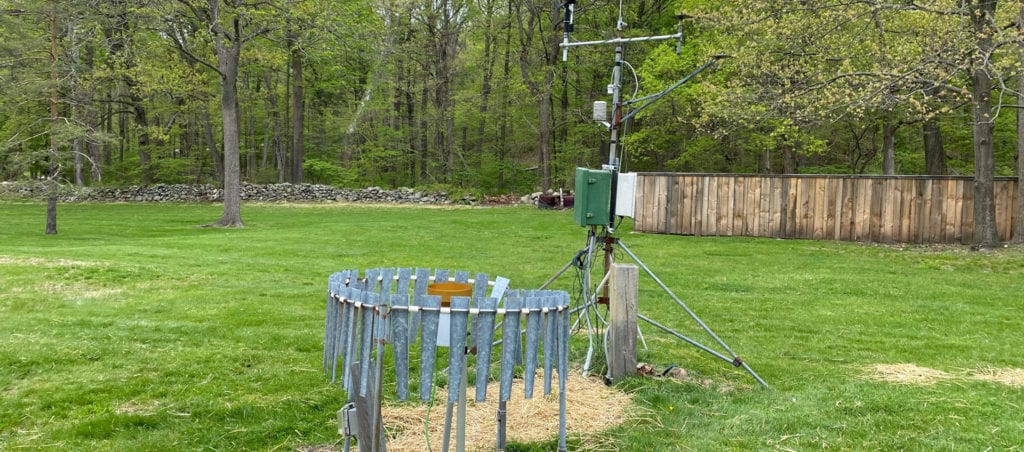
Open Lowland Precipitation: Total rainfall and snow depth have been measured via an aluminum bucket gauge since 1960 in an open meadow at 129 Continental Road, Cornwall, New York.

Open Lowland Environmental Monitoring: Decommissioned in 2023. This station was located within an open meadow at 129 Continental Road, Cornwall, New York and collected air temperature, relative humidity, average vapor pressure, dew point temperature, photosynthetically active solar radiation, net global solar radiation, wind speed and direction, precipitation amount, barometric pressure, soil temperature at two depths, snow depth, CO2 concentration, and albedo.

High Elevation / Forest Interior Environmental Monitoring: in preparation.

Precipitation Amount and Chemistry: Data from the National Atmospheric Deposition Program (NADP) site at Black Rock Forest (station id NY99; formerly located at West Point), include hydrogen ions, sulfate, nitrate, ammonium, calcium, magnesium, conductivity, precipitation, and air temperature.

Snow Depth:in preparation.

Northeast Regional Climate Center provides seasonal outlooks, drought monitors, and access to historic data and maps.

West Point COOP weather station (NY9292) provides the longest continuous record of nearby climate data 1890 – 2025.

Live and Historic Weather via Weather Underground: In July 2025 we installed an Ambient Weather WS-5000 to collect air temperature, precipitation, wind speed, dew point, air pressure, and relative humidity. You can find our current conditions at our site (KNYCORNW67) and the historic data are here.

Wildlife:

Camera trapping: Since 2018, we conduct an annual winter mammal survey with camera traps across ~60 within Black Rock Forest and the surrounding region. All data, metadata, and images are publicly available via wildlifeinsights.org under the studies “EMAMMAL p266” and “Black Rock Forest Mammal Surveys”. We also participate in SnapShotUSA, a nationwide camera trap survey whose data are published online in a variety of outlets.

Carnivore movements: Beginning in 2019 we have attached GPS tracking collars to Bobcat (Lynx rufus) and Fisher (Pekania pennanti) to record their movements (locations at ~2-minute intervals) and behaviors (via accelerometers at 3-minute intervals).

White-tailed Deer Harvest: Black Rock Forest manages a White-tailed Deer (Odocoileus virginianus) harvest program and collects a variety of data from each animal including mass, antler beam diameter and points, teat length (since 2010), chest circumference (1984 – 1998).

White-tailed Deer Pellets: Pellet group surveys were conducted between 2014 and 2024 to assess White-tailed Deer abundance.

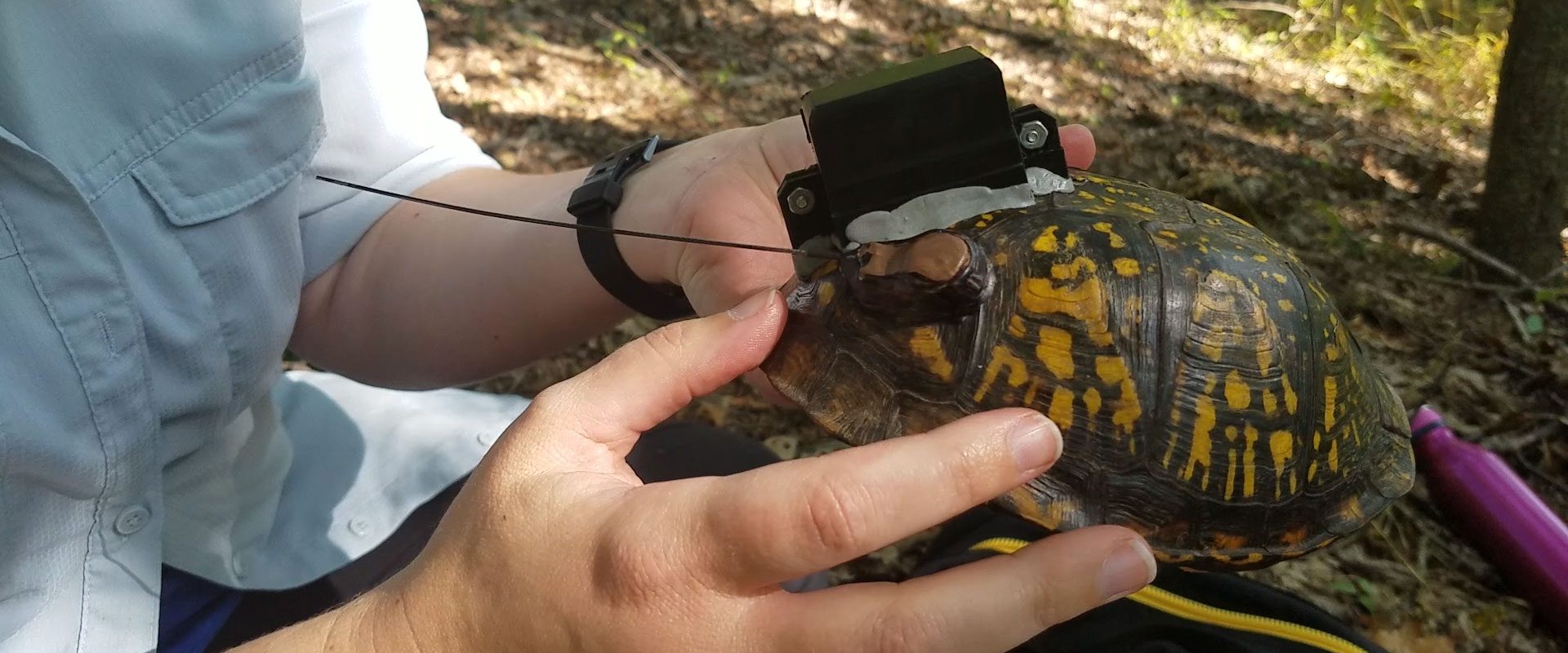
Freshwater Turtle Mark and Recapture: Freshwater turtles have been captured, individually marked, measured, and released at several water bodies throughout the Forest since 1995. Data are in preparation but include species, id, sex, weight, etc.

Plant:

Acorn mast:Acorn mast has been estimated annually since 1995 at 15 to 25 sites across the Forest. Data include location, tree species, count, and abundance.

Tree growth:Black Rock Forest maintains four, paired long-term forest monitoring plots (<0.25-acres), established in 1931, to compare thinning treatments to nearby control plots. Data include tree species, diameter at breast height, tree height and canopy class.

Future of Oak Forests: Twelve 0.56-ha plots were established in 2005 to assess impacts of the loss of Quercus sp. on forest ecosystems via tree trunk girdling treatments. Data include tree species, diameter at breast height, a qualitative assessment of canopy health, presence/absence of sprouts, and location within the plot from 2008 to 2023.

National Phenology Network: Phenological observations have been made on five species along a 1-mile trail since 2021 by Black Rock Forest staff and trained volunteers. Data include presence-absence of phenophases and intensity measurements.

Forest Phenology: As part of the PhenoCam network, images from a phenocam atop our fire tower in the center of the forest are available from 2020 to 2024.

Stand Inventories: Kathleen Stearns Friday and James Boyd Friday conducted a stand inventory (1985) documenting the herb, shrub, and tree species of Black Rock Forest. In 2024-2025, a forest-wide stand inventory was completed (data in preparation).

Seismology:

Data from the seismographic station adjacent to the Science Center were maintained by the Lamont Doherty Cooperative Seismic Network (LCSN) and are now available at NSF SAGE. Black Rock Forest is listed as “BRNY” under the “LD” network.

Hydrology:

Cascade Brook: A stream monitoring station was installed with a 120° v-notch weir in 1998 to continuously monitor the flow, temperature, pH, conductivity, and dissolved oxygen content of the stream water of Cascade Brook. Data from 1998 to 2015 are available here.

Black Rock Forest Stream Flows & Chemistry (1990s – 2010): Stream chemistry, flow, air temperature, and snowpack data from Cascade Brook 1996 – 2008. Data from 6 additional sites in preparation.

Species Lists:

Lichens: Lucy Raup identified 31 species of lichen, as Part III of Raup’s “Botanical studies in the Black Rock Forest”.

Mosses: Peter Nelson and Kerry Barringer collected 63 species of mosses.

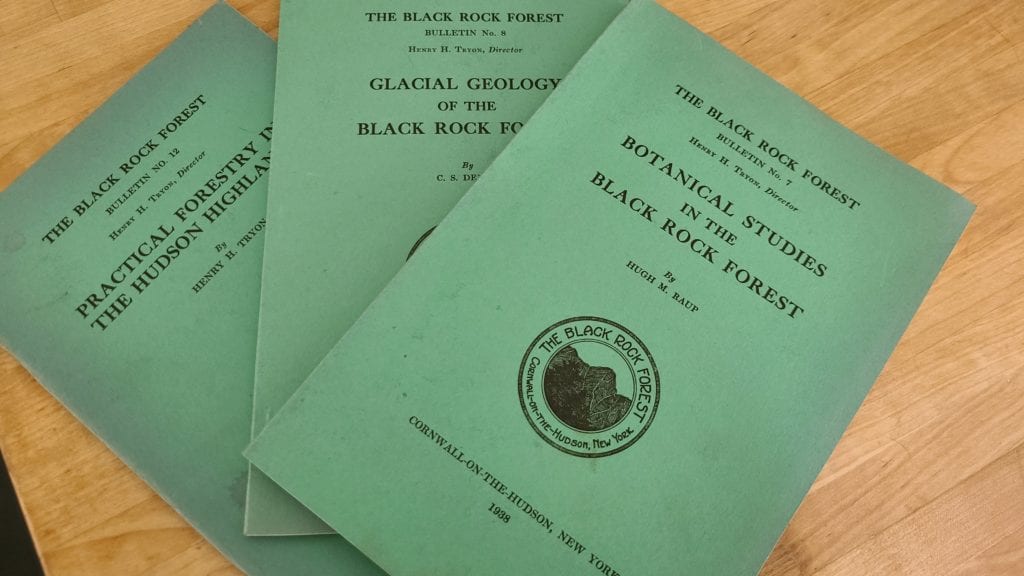
Flora: Hugh Miller Raup produced the first published flora of Black Rock Forest in 1938 (these specimens can be found at the Harvard University Herbaria), followed by Kerry Baringer and Steven Clemants’s 2003 survey of the vascular flora (these specimens can be found on iDigbio and GBIF). Additional specimens collected by Kerry Barringer can be accessed through the Brooklyn Botanical Garden digital herbarium (no images available; search only by species name). Over 400 specimens collected by others from Black Rock Forest can be found at the New York Botanical Garden C.V. Starr Virtual Herbarium.

Invertebrates: Inventories of various Orders of Insecta have been conducted inside Black Rock Forest, including a 2007 ant (Formicidae) by Aaron Ellison et al., a 2014 spider (Araneae) survey by Vladimir Ovtcharenko et al., a 2025 dragonfly (Odonata) survey by Katherine Montana et al. (unpublished), a 2006 bee (Apoidea) survey by Giles and Asher, and a 2025 solitary bee (Megachilidae) survey by Matthew Donahue et al. (unpublished)

Fish: Our understanding of resident fish species is derived from a few electrofishing efforts in 2009 and 2010 within four creeks originating in Black Rock Forest.

Terrestrial vertebrates: Black Rock Forest staff maintain an amphibian, reptile, bird, and mammal species list. Data sources include coverboard surveys, acoustic surveys, direct observations, and camera trap surveys.

Citizen/Community Science sources: Black Rock Forest specific pages exist at iNaturalist, eBird, and iMap Invasives. Please consider contributing your observations during your next visit.

Research Data

Black Rock Forest collects, manages and shares a variety of data, including environmental data ...

Publications

Research at Black Rock Forest spans a broad range of disciplines, with current research ...